Solar Builds — Porter, Texas
Solar Panels Homestead: Our 21kW Ground Mount Build
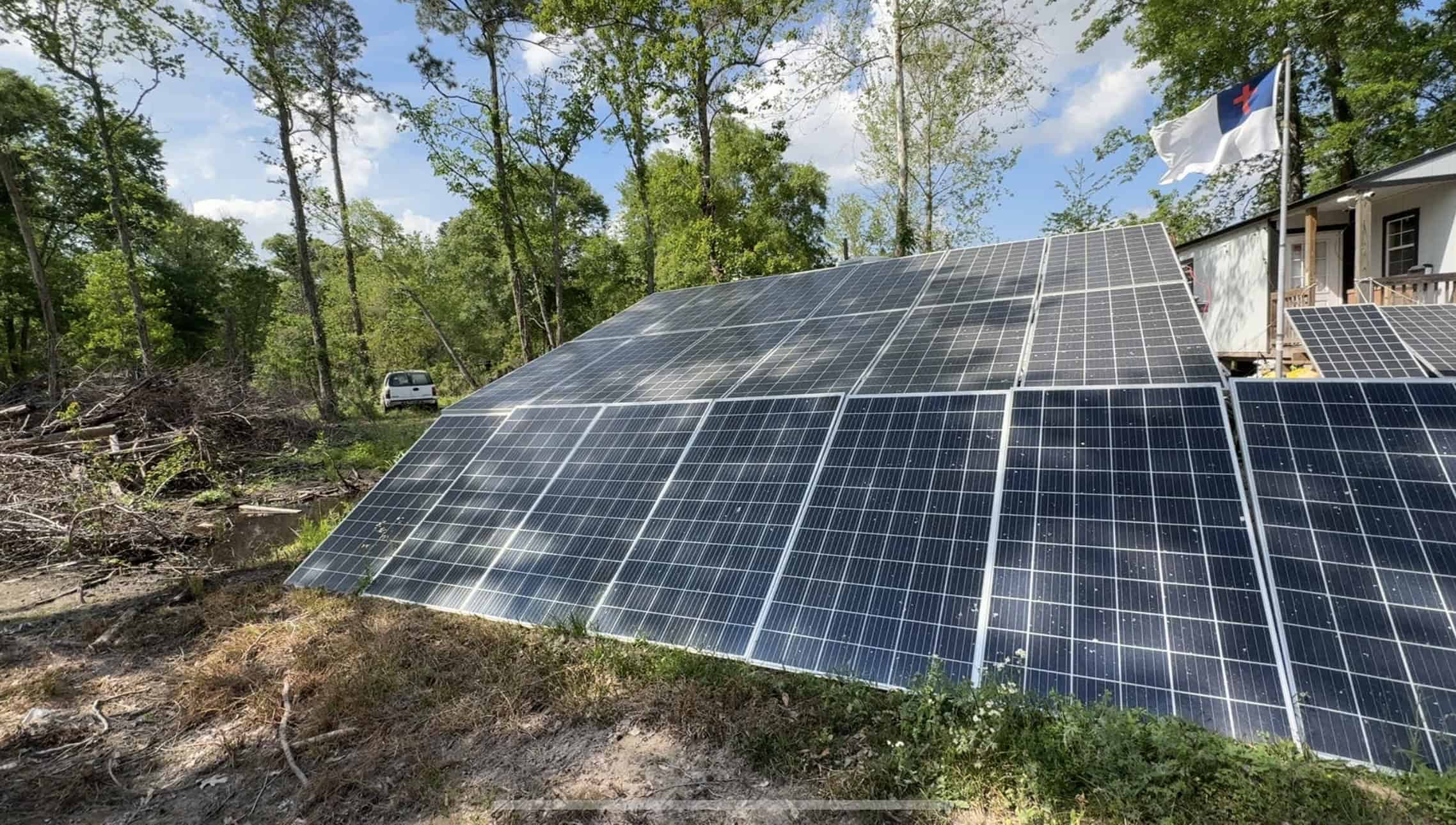
I didn't plan to build a 21kW solar array. I planned to build something small enough to keep the lights on during outages.
Then a brush fire knocked out my main grid breaker. My water pump failed. I was sitting in the dark without water, watching the fire get closer. That was the moment I decided I was done depending on the grid for anything critical.
What you're reading now is the story of what I built after that — from a small backup system to a full 21kW ground-mounted array powering everything on the homestead. This is the complete build breakdown: what we installed, what we learned, what we'd do differently, and what it costs in real Texas dollars.
The Quick Specs
| Spec | Details |
|---|---|
| Total Array Capacity | 21kW |
| Mount Type | Ground Mount |
| Inverter | EG4 12000XP (48V) |
| Battery Bank | 50kWh LiFePO4 (parallel bank) |
| Location | Porter, Texas (40 miles north of Houston) |
| System Type | Off-Grid / Hybrid |
| Status | Live — producing daily |
Why Ground Mount?
In Texas, roof-mounted solar makes sense for a lot of homeowners. For us, it didn't. The homestead has mature trees on the south-facing roofline that would have required significant clearing, and I wanted the flexibility to expand without dealing with roof penetrations and warranty headaches.
Ground mounting also gave us the ability to set the tilt angle exactly where we wanted it for our latitude — which in the Houston area means somewhere around 29–30 degrees for year-round optimization. You don't get that precision on most roof installations.
Lesson Learned
Before you commit to ground mount, know your soil. We hit caliche — the dense limestone layer common under East Texas soil — about 18 inches down. Plan for that if you're in the Houston metro area.
The Array Layout
The 21kW array didn't happen all at once. It grew in stages as needs increased and budget allowed. That's actually one of the advantages of ground mounting — expansion is straightforward. You're not redoing roof work every time you add panels.
The panels feed the EG4 12000XP inverter, which handles the full home load. The system runs in hybrid mode — solar first, battery backup, grid as last resort. In practice, the grid rarely gets used during daylight hours.
On a good Texas day — clear sky, moderate temperature — this array produces more power than the homestead consumes. That surplus charges the battery bank, which then carries overnight loads. That's the goal: produce during the day, run on storage at night, call the grid only when necessary.
The Inverter: EG4 12000XP
The 12000XP is handling the heavy lifting here. 12,000 watts continuous output at 48V — enough to run the well pump, HVAC, and shop tools simultaneously without breaking a sweat.
I also own the EG4 6000XP, which runs a separate system on the homestead. Having run both for over two years, the 12000XP is the right call for anyone trying to power a full house rather than just critical circuits. The extra headroom matters on the hottest Texas summer days when HVAC demand spikes.
The Battery Bank: 50kWh LiFePO4
The battery story on this homestead is a little unusual. I acquired 50kWh of LiFePO4 batteries at a significantly discounted rate through a contact — the full acquisition story is documented on the YouTube channel. The bank is configured in parallel with the EG4 3000EHV-48 and has been running without issues since completion.
LiFePO4 was the only chemistry I considered seriously. In Texas heat, the thermal stability of LiFePO4 is not optional — it's essential. Lead-acid in a Texas summer is a degradation race you will lose.
Real Talk on Battery Sizing
50kWh sounds like a lot until you run the AC through a Texas summer night. Size for your actual overnight consumption, not your optimistic estimate. We have a full battery sizing walkthrough in the Solar Battery Storage guide linked below.
What Surprised Us
Winter Storm Fern Performance
The system got tested hard during Winter Storm Fern. Grid power was out for days across the area. The homestead stayed powered throughout — lights, heat, water pump, refrigeration. That's the whole point of building this system, and it delivered exactly as designed.
Heat Is the Real Enemy
In the Houston area, production in July and August is actually lower than you'd expect despite the long days — because panel efficiency drops as temperature rises. We planned for this and it's still humbling to see it in the monitoring data. Design for your worst case, not your best case.
Monitoring Changes Everything
Once we had real-time monitoring in place, we found two things: loads we didn't know we had, and production patterns we hadn't predicted. If you build a system without monitoring you're flying blind. It's not optional — it's how you actually manage the system.
What This Build Cost
I'm not going to give you a single number because the build happened in stages over time and prices have moved significantly. What I can tell you is that all the equipment came through Signature Solar, where I get the best pricing I've found — and our affiliate link passes that pricing to you at no extra cost.
The most important cost advice I can give: don't undersize the inverter to save money upfront. Upgrading from a 6000W system to a 12000W system later costs far more than buying the right inverter the first time.
Equipment Used in This Build
- Inverter: EG4 12000XP — available through Signature Solar
- Batteries: LiFePO4 — 48V parallel bank (50kWh total)
- Panels: 27 × Adani 335W + 32 × 370W — 21kW total
- Mount: Ground mount racking — fixed tilt
- Monitoring: Inverter-integrated monitoring via EG4 app
Build Your Own System
All the equipment from this build is available through Signature Solar. Use our affiliate link for $50 off and free shipping on qualifying orders.
Shop Signature Solar → Read the EG4 12000XP Review