Solar Builds — Porter, Texas
50kWh LiFePO4 Battery Bank: How We Built It and What We Learned
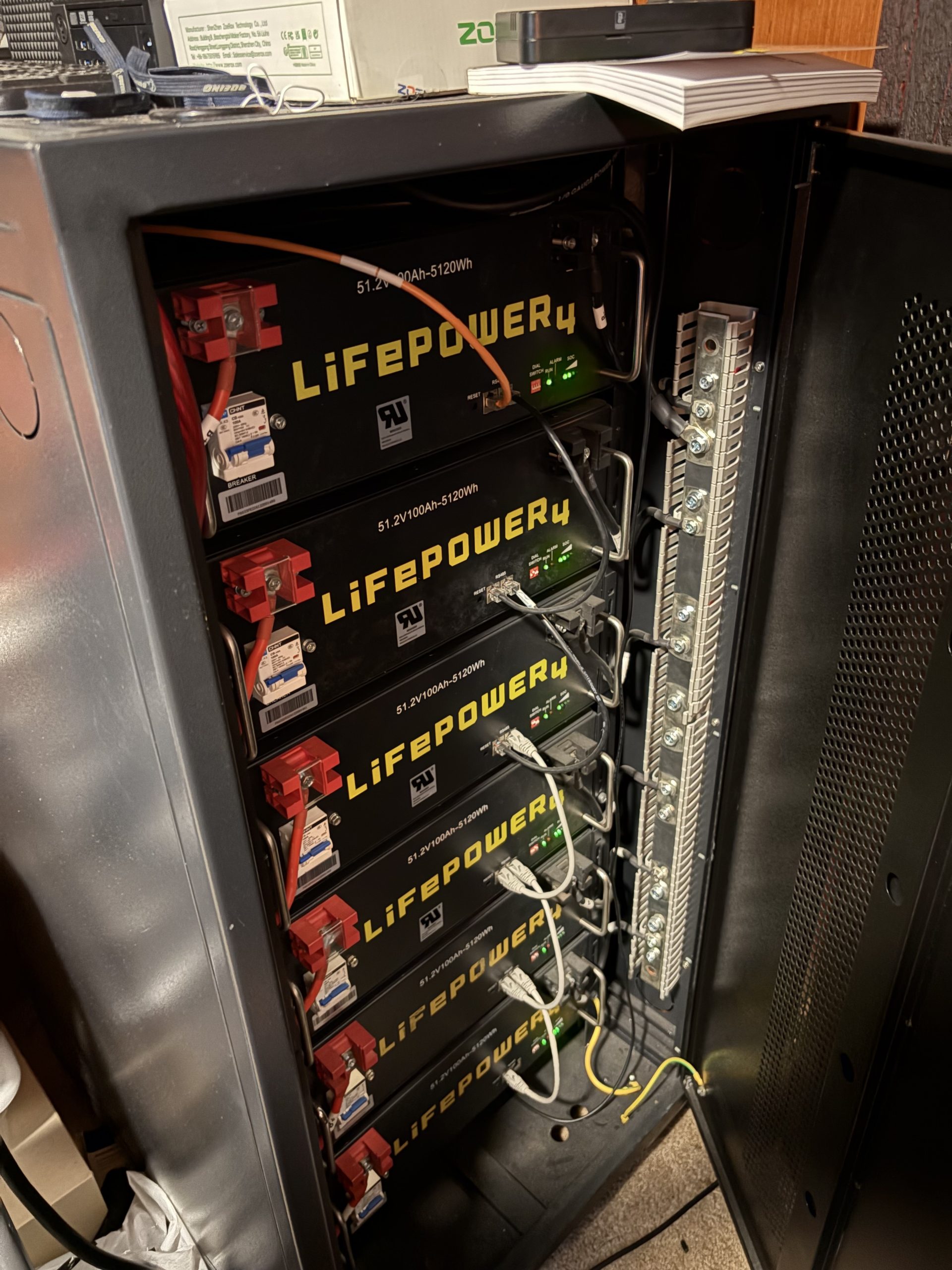
Most people building a solar storage system buy their batteries new from a distributor. That’s the straightforward path — and for most people, it’s the right one.
Our 50kWh LiFePO4 battery bank came together differently. The acquisition story is documented on the YouTube channel — the short version is that I acquired a significant quantity of LiFePO4 batteries at a deeply discounted rate through a contact, which made a 50kWh bank financially viable in a way it wouldn’t have been at full retail pricing.
Whether you’re buying new or sourcing creatively, the build principles are the same. This post covers how we assembled, wired, and commissioned the 50kWh parallel bank — what we got right, what we’d do differently, and what you need to know before you build your own.
Bank Specs at a Glance
| Spec | Details |
|---|---|
| Total Capacity | 50kWh |
| Chemistry | LiFePO4 (Lithium Iron Phosphate) |
| System Voltage | 48V |
| Configuration | Parallel bank |
| Inverter Pairing | EG4 3000EHV-48 |
| Connected Systems | All three homestead inverters |
| Location | Porter, Texas homestead |
| Status | Live — running daily ✓ |
Why LiFePO4 — And Why It’s Not Even a Close Call in Texas
There are people who still argue for lead-acid batteries in off-grid solar systems. I understand the argument — lower upfront cost, widely available, well-understood technology. But in Texas, that argument falls apart fast.
LiFePO4 batteries have a thermal stability advantage that matters enormously when your battery bank is sitting in ambient temperatures that regularly exceed 90°F in summer. Lead-acid batteries degrade faster at high temperatures, require more maintenance, and need precise charge voltage adjustments or they sulfate. LiFePO4 handles Texas heat without complaint.
The real cost comparison: Lead-acid is cheaper per kWh upfront. LiFePO4 lasts 3–5x longer with proper management. Over a 10-year horizon in a Texas climate, LiFePO4 is almost always the cheaper option when you factor in replacement cycles, capacity degradation, and maintenance time.
Why Not Other Lithium Chemistries
NMC (Nickel Manganese Cobalt) batteries offer higher energy density but at the cost of thermal stability. For a stationary home storage application in Texas, you don’t need the density advantage — you need the stability. LiFePO4 is the chemistry that was designed for exactly this use case.
Parallel Bank Configuration
A parallel battery bank connects multiple batteries positive-to-positive and negative-to-negative, which increases total capacity while maintaining the same system voltage. Our 48V bank is built in parallel — multiple batteries at 48V combined to reach 50kWh total capacity.
Parallel configurations require careful attention to a few things that series configurations don’t:
- Equal cable lengths — Every battery in a parallel bank needs the same cable length to the bus bar. Unequal lengths create unequal resistance, which causes unequal charging and discharging. Measure and cut every cable to the same length.
- Matched batteries — Parallel batteries should be the same chemistry, same capacity, and ideally the same age. Mixing old and new batteries in parallel causes the newer batteries to compensate for the older ones.
- Bus bar sizing — The bus bar connecting a 50kWh parallel bank carries the combined current of all batteries. Undersize it and you create a heat and resistance problem at the exact point where all your power flows.
- Fusing per string — Each parallel string needs its own fuse as close to the battery as possible. A short in one string without proper fusing can discharge the entire bank through that fault.
The Mistake Most People Make
Skipping equal cable lengths because it seems like a small detail. It isn’t. We measured every single interconnect cable before cutting. Your parallel bank will only balance properly if every current path has equal resistance — and cable length is the primary variable you control.
The Build Process
- Battery placement and racking — Batteries positioned in their final location before any wiring. LiFePO4 batteries are heavy. Move them into position before they’re connected to anything.
- Bus bar installation — Properly sized positive and negative bus bars installed. All parallel connections terminate here rather than daisy-chaining battery to battery.
- Cable cutting and termination — Every cable cut to equal length, terminals crimped and heat-shrunk. No variance in cable length between strings.
- Fuse installation per string — Individual fuses installed on each positive connection as close to the battery terminal as possible.
- State of charge equalization — Before connecting batteries in parallel, confirm all batteries are at the same state of charge. Connecting batteries at different SOC causes immediate high-current equalization that stresses terminals and connections.
- Inverter connection — Bank connected to the EG4 3000EHV-48 with properly sized main cables and a main disconnect fuse at the battery bank output.
- BMS communication setup — Battery Management System communication configured between batteries and inverter for accurate state-of-charge reporting and charge management.
- Initial commissioning — Full charge cycle, load test, and monitoring verification before putting the bank into regular service.
Living With 50kWh of Storage
What It Actually Covers
50kWh is enough storage to run this homestead through a typical Texas night with significant margin remaining by morning. On a good production day — clear sky, moderate temperature — the 21kW array fills the bank well before sunset and we’re running purely on storage from dusk until the panels come back online.
Where It Gets Tight
Extended cloudy periods in winter are the real test. Three or four overcast days in a row and the bank starts drawing down meaningfully. That’s what the generator backup is for — not daily use, but as a bridge during the rare stretches when solar production is significantly below average for multiple days.
Temperature Management
LiFePO4 batteries have a charge temperature limitation — most won’t accept a charge below 32°F (0°C). In Porter, Texas, that’s rarely an issue. But if you’re building in a climate that sees hard freezes, factor battery heating into your design. Discharging in cold temperatures is generally fine; charging is where you can damage cells.
Sizing Advice
Size your battery bank for your actual overnight consumption, not your average consumption. The average includes nights where you barely draw anything. The bank needs to cover your worst-case overnight load — peak summer AC running all night — with meaningful reserve remaining at dawn. If you’re not sure what that number is, install a battery monitor first and measure for 30 days before buying batteries.
Equipment Used
- Battery Chemistry: LiFePO4 — 48V parallel bank
- Total Capacity: 50kWh
- Primary Inverter: EG4 3000EHV-48
- Connected To: EG4 12000XP, EG4 6000XP, EG4 3000EHV-48 studio system
- Array: 21kW ground mount — 27 Adani 335W + 32 × 370W panels
- Source: EG4 LifePower4 batteries available through Signature Solar
Build Your Battery Bank
EG4 LifePower4 LiFePO4 batteries for off-grid solar storage are available through Signature Solar. Use our affiliate link for $50 off and free shipping on qualifying orders.
Shop EG4 Batteries at Signature Solar → Read the Full Battery Review