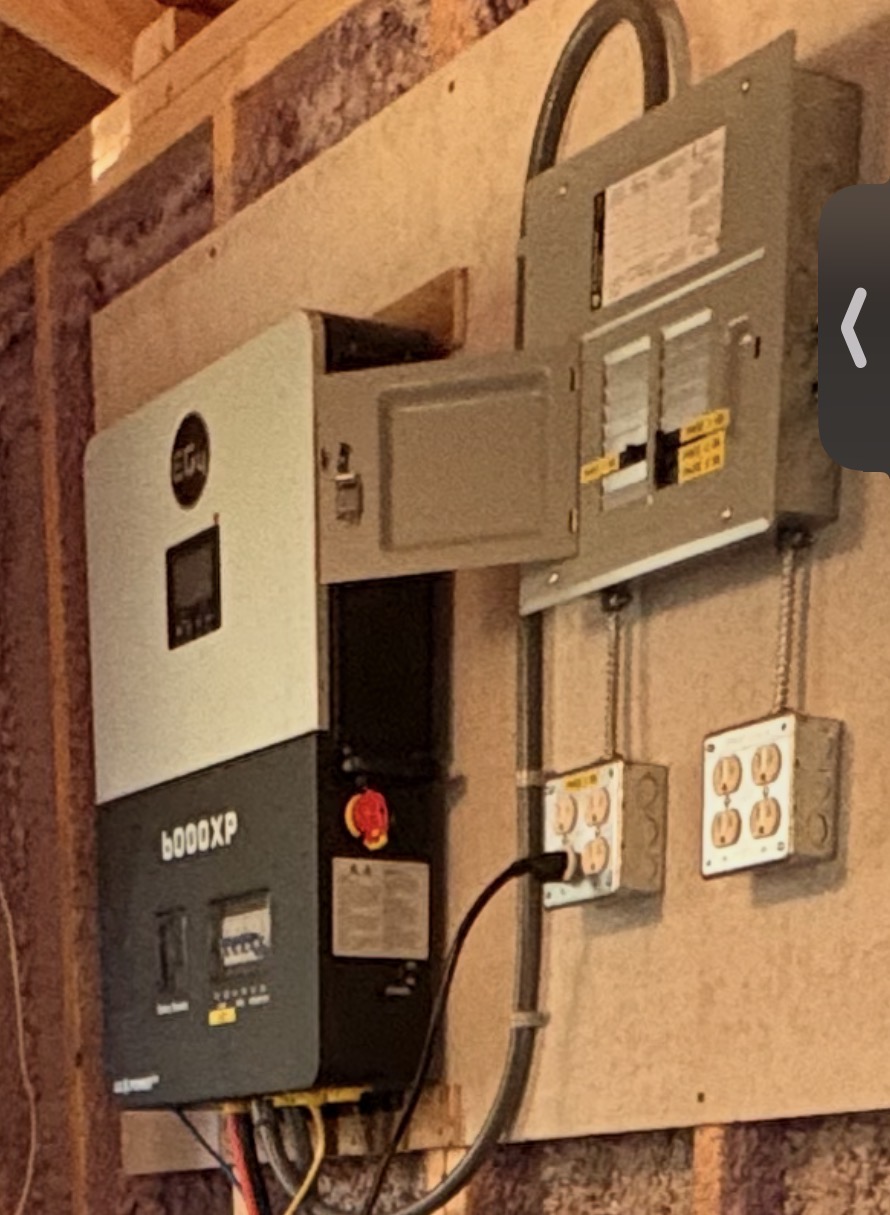
If you're trying to decide between the EG4 6000XP vs 12000XP, you're asking the right question before spending $2,000–$4,000. I've run both on my one-acre homestead in Porter, Texas — the 6000XP first, then added the 12000XP when my loads outgrew it. This isn't a spec-sheet comparison. It's what actually happens when you run these inverters in real Texas heat with a real off-grid system. Either way, before you buy, grab the current Signature Solar coupon code — it's $50 off whichever inverter you pick.
Short answer: the 6000XP is the right inverter for most people starting out. The 12000XP is the right inverter when you need to power the whole home — everything, all at once, without compromise. Here's how to know which one you actually need.
EG4 6000XP vs 12000XP: Side-by-Side Comparison
| Spec | EG4 6000XP | EG4 12000XP |
|---|---|---|
| Continuous Output | 6,000W | 12,000W |
| Surge Capacity | 12,000W | 24,000W |
| Max Parallel Units | 16 units (96kW) | 6 units (72kW) |
| Solar PV Input | 8,000W / 1 MPPT | 24,000W / 2 MPPT |
| Smart Load Port | No | Yes — programmable |
| Generator Support | Basic auto-start (dry contact) | 2-wire start/stop + Gen Boost mode |
| Whole Home Coverage | Critical loads / partial | Full home — all circuits |
| Best For | Cabin, small home, starter system | Full homestead, high-demand loads |
| Price Range | Lower upfront cost | Higher upfront cost |
Ready to order? Use code SOLARHOME50OFF at checkout
$50 off your order at Signature Solar — or click below and it applies automatically
Shop EG4 Inverters at Signature Solar →The EG4 6000XP: Who It's Actually For
The 6000XP was my first inverter and it ran this homestead through a hurricane without a hiccup. That's not a marketing claim — we literally installed it right before a storm hit and it never let us down. Fridge, freezer, lights, ceiling fans, TV, two mini-splits, and a well pump all running off one 6000XP.
At 6,000 watts continuous output, this inverter is genuinely capable for a small to medium off-grid setup. The key word is simultaneous loads. Where the 6000XP gets tight is peak demand — a hot Texas afternoon when the HVAC is running hard, the well pump kicks on, and someone starts the microwave. You're not going to blow the inverter, but you'll feel the headroom disappear.
The 6000XP is the right choice if:
- You're powering a cabin, small home, or critical loads subpanel
- Your peak simultaneous load stays under 5,000–5,500W
- You're budget-conscious and want room to expand later (up to 16 units in parallel)
- You're just starting out with solar and want a reliable, easy-to-install unit
- You don't need the smart load port or advanced generator management
One 8,000W PV input with a single MPPT is enough for most starter arrays. Installation is straightforward — this is a great first inverter. It's been mine, and I'd recommend it to anyone with moderate energy needs and a budget to match.
The EG4 12000XP: When You Need the Whole Home
The reason I added a 12000XP wasn't that the 6000XP failed. It was that the homestead grew. More equipment, more circuits, more simultaneous loads — and a Texas summer that makes no apologies. Running a 6,000W inverter at 80–90% capacity in 100-degree heat is running it hard. The 12000XP running the same load sits at 60–70% capacity. That headroom matters for longevity.
The 12000XP handles the full house — every circuit, all at once. HVAC, well pump, kitchen, shop equipment, everything running simultaneously without the inverter sweating it. The dual MPPT inputs accept up to 24,000W of PV, which makes it the right match for a larger array.
Features that actually matter on the 12000XP:
- Smart Load Port — prioritize critical loads automatically when battery is low. This is genuinely useful, not a gimmick.
- Gen Boost Mode — combine a smaller generator with battery power to handle temporary high loads. Saves fuel, adds flexibility.
- 2-wire generator start/stop — more control than the basic dry contact on the 6000XP
- Dual MPPT — better for larger or split-orientation arrays
- 24,000W surge capacity — handles heavy motor starts cleanly
One real-world note: the 12000XP is significantly heavier than the 6000XP. Plan your mounting location before the unit arrives. Two people minimum for installation, three is better. Mount it indoors in a climate-controlled space if you're in Texas — ambient heat is not your friend with high-power electronics.
The 12000XP is the right choice if:
- You're powering a full home — all circuits, not just critical loads
- You run heavy equipment: large HVAC, well pump, welder, or multiple high-draw appliances simultaneously
- You're in a hot climate (Texas, Arizona, Southeast) where inverter thermal management matters
- You want the smart load port for advanced load management
- You have or plan a large solar array (12kW+)
- You want enhanced generator integration with Gen Boost
How They Perform Together on This Homestead
On this Porter, Texas homestead, both inverters run simultaneously and independently. The 12000XP handles the main house — all circuits, full load. The 6000XP runs a separate load group. This gives us built-in redundancy: if one system needs maintenance, the other keeps running. Both draw from the same 21kW ground mount array and the same 50kWh LiFePO4 battery bank. Curious what running a home entirely on battery really looks like day to day? See our honest breakdown: the truth about whole home backup.
Two Texas summers and one winter storm later — the setup has handled everything. During Winter Storm Fern, the grid was out across the area and this homestead ran entirely on solar and battery. There's more to battery backup than most marketing lets on — here's what nobody tells you about battery backup. Heat, water, refrigeration, lighting — all maintained. We've run the generator twice in two years, both times during extended cloudy stretches in winter. The 12000XP handles generator input cleanly and the Gen Boost mode is exactly as useful as advertised.
If I were starting over from scratch today knowing what I know: I'd still start with the 6000XP if budget was a constraint, and I'd plan the upgrade to the 12000XP from day one. The 6000XP earns its place. But if you're building a whole-home system and the budget allows — go straight to the 12000XP and don't look back.
Which One Should You Buy?
Choose the EG4 6000XP if:
- Cabin or small home
- Critical loads only
- Budget under $2,000
- Starting your first system
- Peak loads under 5,500W
Choose the EG4 12000XP if:
- Full home coverage
- Heavy simultaneous loads
- Hot climate (TX, AZ, SE)
- Large solar array (12kW+)
- Want smart load management
Once you've settled on your inverter, grab the current Signature Solar coupon code before you order — it takes $50 off either the 6000XP or the 12000XP, and it applies automatically when you buy through the link.
Frequently Asked Questions
Can you run an EG4 6000XP and 12000XP together?
Yes — that's exactly what we do on this homestead. They run as separate independent systems on separate load groups, both drawing from the same battery bank and solar array. This gives redundancy: if one needs service, the other keeps its loads running.
Is the EG4 12000XP worth the extra cost over the 6000XP?
If you're powering a full home with heavy simultaneous loads — yes, without question. If you're powering a cabin or critical loads only, the 6000XP is the better value. The 12000XP earns its price premium in thermal headroom, dual MPPT, smart load management, and Gen Boost. For partial-home setups, those features aren't worth the cost difference. If you're trying to decide whether to expand your inverter setup, your solar array, or your battery bank next, see more solar or more battery — which should you add first?
How many EG4 6000XP units can you run in parallel?
Up to 16 units, giving you up to 96kW of continuous output. The 12000XP maxes out at 6 units parallel (72kW). For most residential applications this distinction doesn't matter, but it's worth knowing if you're planning a very large system.
Does the EG4 6000XP have a smart load port?
No — the smart load port is exclusive to the 12000XP. It allows you to prioritize certain loads and dynamically shed non-critical loads when battery is low. If you need that level of load management, it's a 12000XP feature only.
What's the difference in generator support between the two?
The 6000XP has basic generator auto-start via dry contact. The 12000XP adds a 2-wire start/stop and Gen Boost mode, which lets you combine a smaller generator with battery power to handle temporary high loads — saving fuel and giving more flexibility. If you rely on a generator regularly, the 12000XP's gen support is meaningfully better.
Save $50 on Either Inverter
Use code SOLARHOME50OFF at checkout — or click below and it applies automatically
Verified affiliate link — I use Signature Solar for all my equipment