Solar Builds — Porter, Texas
EG4 6000XP System Build: How We Wired It and What We Learned
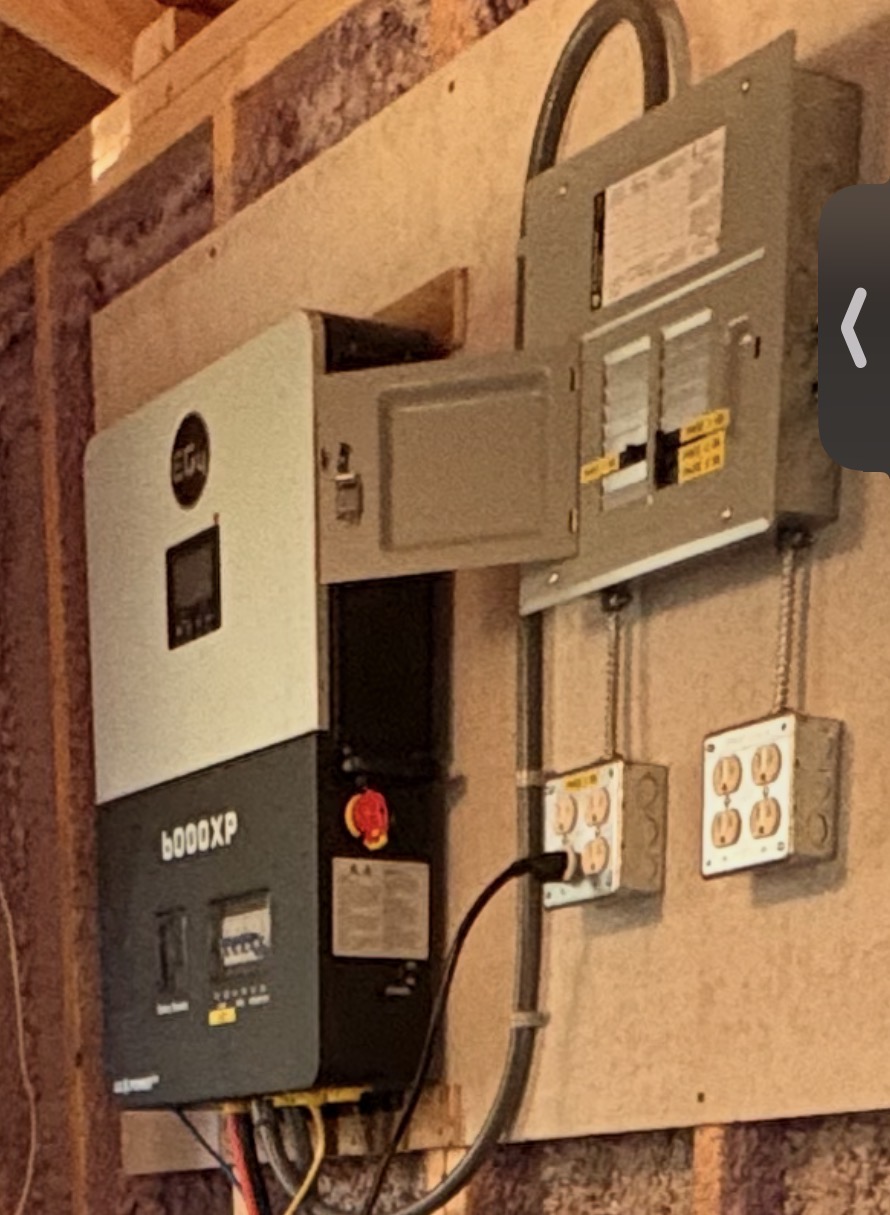
I bought my EG4 6000XP in April 2024. Not because I had done extensive research comparing every inverter on the market — but because I needed reliable backup power for my homestead in Porter, Texas, and the 6000XP was the best value all-in-one inverter I could find for the job.
That was over two years ago. It’s been running daily ever since — through two brutal Texas summers, a major winter storm, and everything in between.
This post covers the build itself: how the system is wired, what components we paired it with, what the installation process actually looked like, and the decisions we made along the way. If you want the performance verdict after two years of ownership, that’s covered in the full EG4 6000XP review.
System Specs at a Glance
| Spec | Details |
|---|---|
| Inverter | EG4 6000XP |
| System Voltage | 48V |
| Continuous Output | 6,000W |
| Peak Output | 12,000W surge |
| Battery Bank | LiFePO4 — 48V (EG4 LifePower4) |
| Solar Input | Connected to homestead array |
| Location | Porter, Texas homestead |
| In Service Since | April 2024 |
| Status | Live — running daily ✓ |
Why the EG4 6000XP
The decision came down to a few things. First, Signature Solar is based in Texas — which matters when you need support and don’t want to deal with overseas shipping on a warranty claim. Second, the 6000XP is a true all-in-one: MPPT charge controller, inverter, and battery charger in a single unit. For a homestead installation where I’m doing the wiring myself, fewer components means fewer connection points and fewer failure opportunities.
Third — and this is the honest answer — the price-to-capability ratio at the time of purchase was hard to beat. 6,000 watts continuous, 12,000 watt surge capacity, 48V system voltage. For running a well pump, HVAC circuits, and standard household loads simultaneously, it’s the right tool.
One thing I didn’t fully appreciate before buying: the 6000XP handles well pump surge loads exceptionally well. A submersible well pump can pull 3–4x its running wattage on startup. The 12,000W surge capacity on the 6000XP handles this without the inverter faulting — which is not true of every inverter in this class.
The Installation: How We Wired It
The 6000XP installation on this homestead went in as a dedicated system — not a whole-home replacement from day one, but a purpose-built backup system for critical loads. Here’s the sequence we followed:
- Mount location selection — We mounted the inverter in a protected indoor location, away from direct heat and moisture. In Texas heat, ambient temperature matters for inverter longevity. Don’t mount these in an unventilated outdoor enclosure.
- Battery bank wiring — LiFePO4 batteries connected to the inverter with appropriately sized cable. For a 48V system at 6,000W continuous, you’re looking at 125A continuous draw minimum — wire sizing is not a place to cut corners.
- Solar array connection — MPPT inputs wired from the array. The 6000XP has a generous MPPT input range which gives flexibility in array configuration.
- AC output connection — Critical loads subpanel fed from the inverter output. We used a transfer switch setup so grid and solar/battery can hand off cleanly.
- Grid input connection — Grid tied to the AC input for backup charging and pass-through when needed.
- Monitoring setup — Connected to the EG4 monitoring app to track production, consumption, and battery state in real time.
Installation Tip
The EG4 6000XP is heavy. Have a second person available for the mounting step — trying to hold it against the wall while driving lag bolts solo is exactly the kind of situation where expensive equipment gets dropped.
Battery Pairing
The 6000XP is paired with a LiFePO4 battery bank at 48V. LiFePO4 was the only real choice for a Texas homestead — the thermal stability at high ambient temperatures is in a different class from lead-acid, and the cycle life justifies the upfront cost over a 10-year horizon.
The EG4 6000XP communicates with compatible LiFePO4 batteries via CAN bus for state-of-charge management. If your batteries support this, use it — it lets the inverter manage charging more accurately than voltage-based estimation alone.
Load Management on the 6000XP
One feature that gets underused on the 6000XP is the Smart Load output — a separate AC output that can be programmed to activate only when battery state of charge is above a set threshold. We use this to capture surplus solar energy for non-critical loads rather than letting it go to waste.
In practice: when the battery bank is full and solar is still producing, excess energy routes to the Smart Load output rather than being clipped. For a homestead with a water heater or well pressure system, this is free energy that would otherwise be wasted.
What We’d Do Differently
We’d install the dedicated monitoring shunt from day one rather than adding it later. Understanding your actual consumption patterns early changes how you manage the system — and the data is invaluable for diagnosing any issues that come up.
EPS Mode: What You Need to Know
The 6000XP supports EPS (Emergency Power Supply) mode — essentially instant switchover from grid to battery when grid power fails. The transition is fast enough that most sensitive electronics don’t even notice the interruption.
We did work through an EPS fault early in the system’s life — caused by a configuration issue rather than a hardware problem. If you see EPS faults on your 6000XP, check your firmware version first. EG4 has pushed several firmware updates that addressed early EPS behavior.
How It Fits Into the Larger Homestead System
The 6000XP runs alongside the EG4 12000XP on this homestead — two separate systems serving different load groups. The 6000XP handles the loads it was originally sized for; the 12000XP handles whole-home capacity. Running both gives us redundancy: if one system needs maintenance, the other keeps critical loads running.
For anyone building a single-system setup and trying to choose between the two, the comparison is covered in detail in the 6000XP vs 12000XP comparison guide.
Equipment List
- Inverter/Charger: EG4 6000XP — all-in-one, 48V, 6,000W continuous
- Batteries: EG4 LifePower4 48V 100Ah LiFePO4 server rack batteries
- Monitoring: EG4 app + dedicated battery shunt
- Transfer Switch: For clean grid/solar handoff on critical loads
- Source: All equipment purchased through Signature Solar
Get the EG4 6000XP
Purchased mine through Signature Solar in April 2024 — still running strong. Use our affiliate link for $50 off and free shipping on qualifying orders.
Shop at Signature Solar → Read the Full Review